

The integration of RTOS is no longer an option—it is a requirement for deterministic performance in complex environments.In the high-stakes world of defense and aerospace, every millisecond counts. 7Starlake invites you to an exclusive technical webinar exploring the synergy between Real-Time Operating Systems (RTOS) and Next-Gen Radar Subsystems.



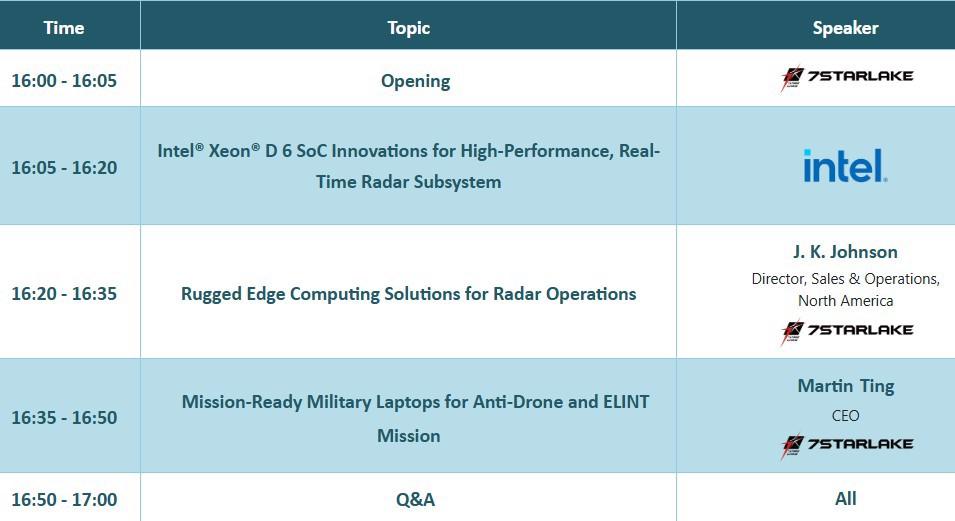

WEBINAR DETAILS
🗓 February 12, 2026
🕓 4:00–5:00 PM PST
🌐 Online Webinar

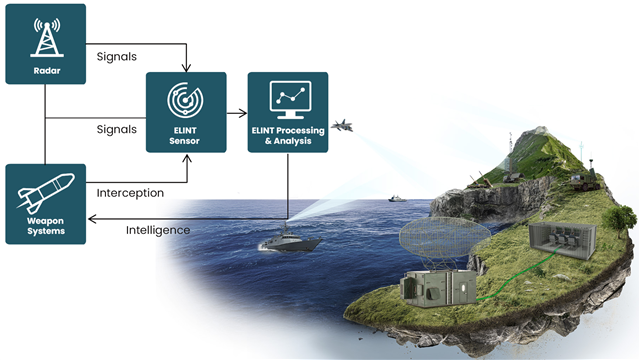
The Role of Modern Hardware in ELINT Operations
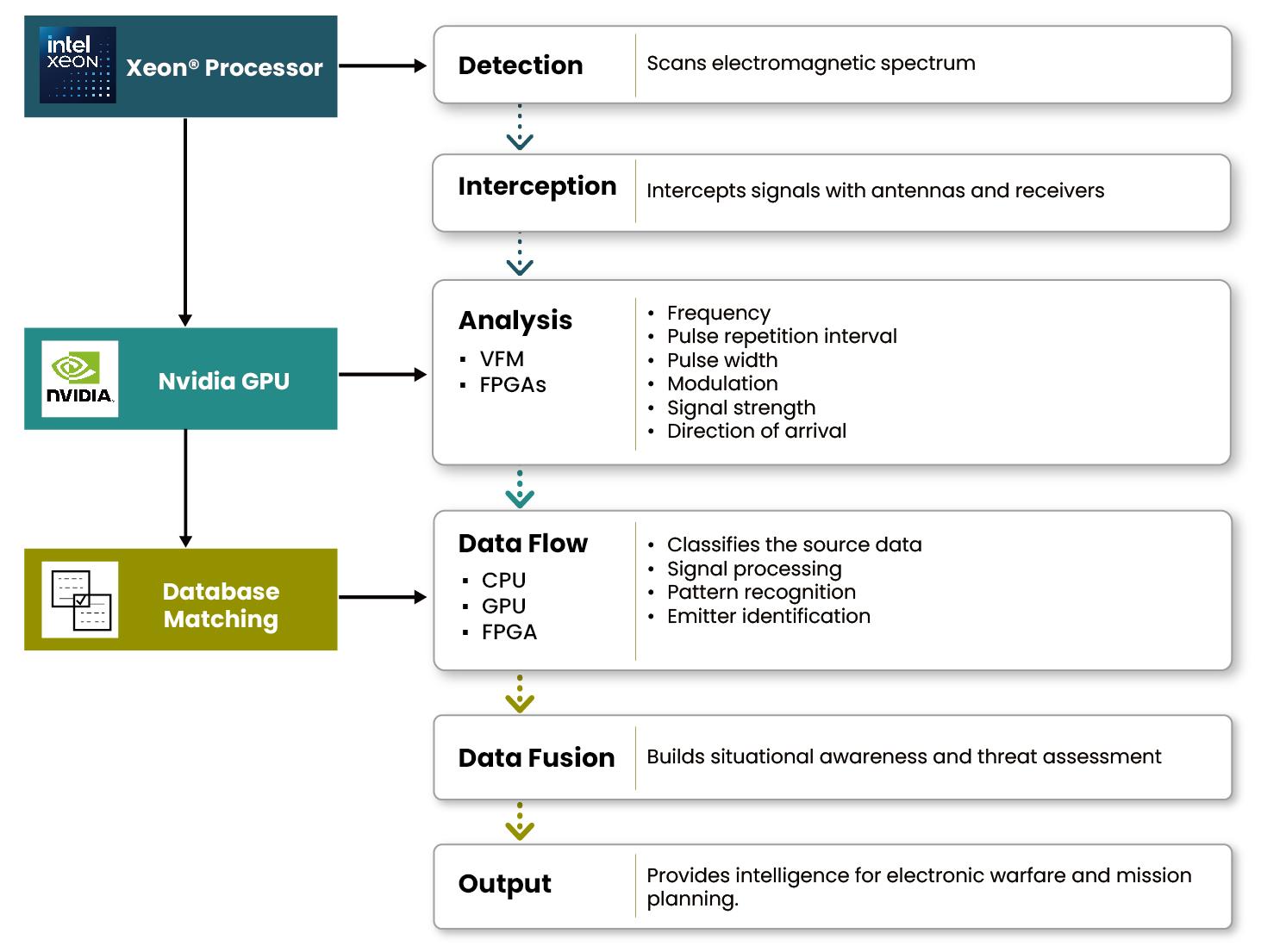
Electronic Intelligence (ELINT) systems monitor radio and microwave spectra to detect radar and other non-communication signals. Detected emissions are intercepted by specialized receivers on platforms such as aircraft, ships, or satellites, then analyzed for key parameters like frequency, pulse, modulation, and direction. The system identifies and locates the emitter, matches it against known databases, and delivers actionable intelligence for electronic warfare, mission planning, and threat assessment.
Detecting and Avoiding Enemy Radar Systems
Challenge: Stealth aircraft and reconnaissance drones must evade detection by enemy radar.
Solution: ELINT systems scan for radar emissions, classify threats, and provide real-time avoidance routes.
Hardware Role:
- FPGAs perform ultra-low-latency spectrum scanning.
- NVIDIA GPUs accelerate radar signature recognition using deep learning.
- Xeon® CPUs manage mission-critical decision-making.
Supporting Stealth Aircraft Operations
Challenge: Stealth platforms must remain undetected while identifying hostile radars.
Solution: ELINT systems onboard stealth aircraft classify radar threats and recommend countermeasures.
Hardware Role:
- FPGAs handle high-speed signal interception.
- GPUs run AI models for adaptive jamming strategies.
- Xeon® CPUs coordinate with onboard EW systems.
Developing Countermeasures (Jamming & Spoofing)
Challenge: Adversaries employ advanced radar systems with frequency agility.
Solution: ELINT-driven Electronic Attack (EA) systems generate deceptive signals to mislead enemy sensors.
Hardware Role:
- FPGAs generate real-time jamming waveforms.
- GPUs optimize countermeasure algorithms.
- Xeon® CPUs manage system-wide coordination.
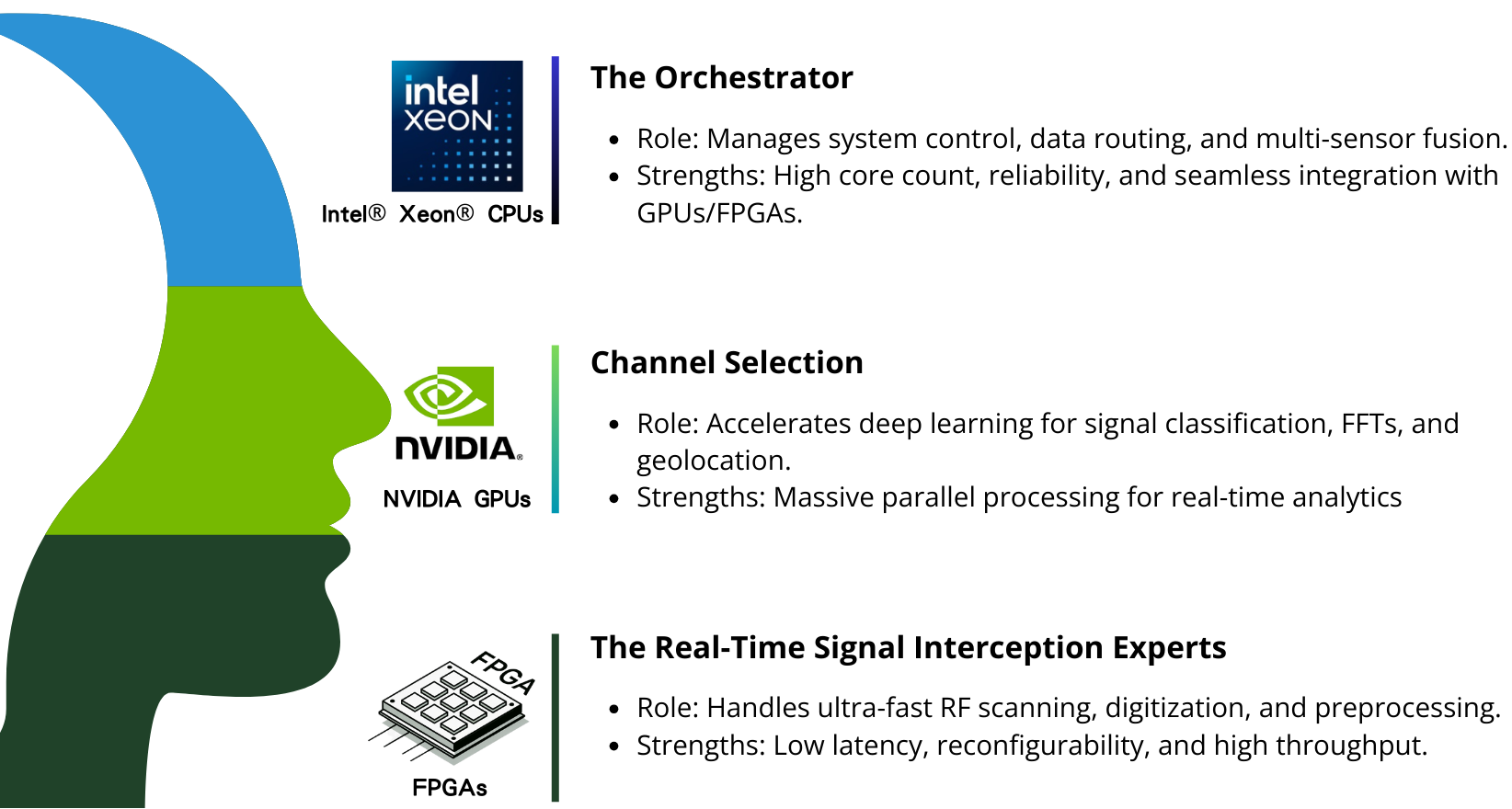
Modern ELINT systems demand high-speed processing, real-time analysis, and seamless data fusion across multiple domains. To meet these requirements, cutting-edge platforms leverage a heterogeneous hardware architecture that combines the strengths of CPUs, GPUs, and FPGAs. Each component plays a distinct role in delivering performance, flexibility, and reliability in mission-critical environments.
- Mission Critical Intelligence: Real-time data processing for USVs and UGVs.
- Extreme Durability: Overcoming thermal and mechanical challenges in the field.
- The Future of Autonomy: Navigating the shift from remote control to full AI-driven operations.

In this webinar, we will go beyond the basics to discuss how these hardware components (Xeon, GPU, FPGA) synergize with RTOS to solve the most complex ELINT challenges. Join us to see the live breakdown.